

90020_3805_Creating_the_Telegraph_01
This 1950s educational clip focuses on the workings of the telegraph, an electric machine that quickly transmits information over long distances.
The clip begins with a drawn portrait of a noble-looking Samuel Morse.
The narrator tells us Morse combined three inventions -- the electric battery, the conducting wire, and the electro magnet.
We see the image of a “sending instrument” and a “receiving instrument.” Both are connected to wires, and these wires are connected to the same battery.
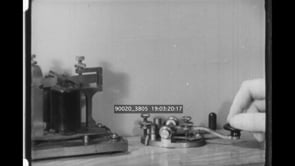
The narrator says that pressing a key or button on the sending instrument starts a flow of electricity from the battery through the wires, and causes an impulse to flash on the receiving instrument. The impulse brings together two pieces of metal together, producing a click or clicking sound. This is the original model of the world’s first telegraph, the narrator tells us.
The narrator tells us that the first telegraph message was sent in 1844 between Washington D.C. and Baltimore, Maryland. We see two points on a map that are connected by a wire running between them. The phrase “WHAT HATH GOD WROUGHT” appears on the screen, superimposed over the map.
The camera focuses on a hand that is pressing a key on a telegraph. This image is then superimposed over coverage of a cowboy traveling quickly by horseback, a stagecoach rolling screen left, horses being released from a burning barn, and a group of cowboys traveling toward the camera and being lead by an energetic fellow cowboy.